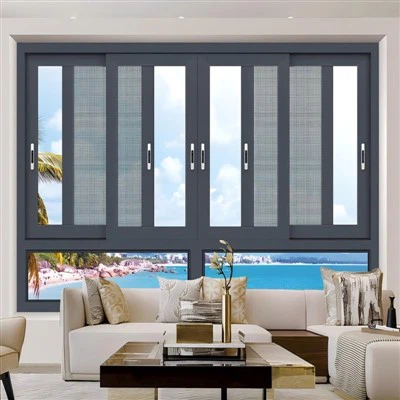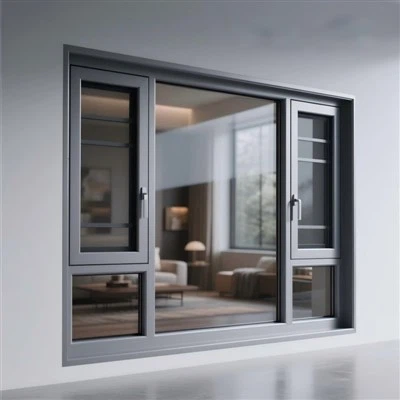

If you're considering converting your aluminum alloy sliding windows to casement windows, it's advisable to think carefully. The style of the window and door profiles is usually determined initially, and they can typically only be made as sliding windows; they cannot be directly converted to casement or single-opening windows. If this is indeed the requirement, the entire sliding window must be removed and replaced with an insulated aluminum casement or valance window, and double-glazed windows should be used to enhance indoor insulation.
Aesthetically, casement windows and sliding windows do have significant differences, primarily in their coordination with the overall style of the building. Casement windows offer great flexibility, allowing for a wide variety of facade effects, and even floor-to-ceiling windows can be designed, where the opening sash occupies only a small portion of the entire window, thus fully realizing the architect's design concept of spaciousness, brightness, and transparency.
Sliding windows are limited to horizontal sliding, making them relatively difficult to match with large fixed glass panes. Typically, these sliding windows are more suitable for buildings with distinct horizontal and vertical lines, such as factories or rural homes, where they are commonly seen. Price Comparison: Casement windows are generally more expensive than sliding windows. Specifically, the market price for ordinary aluminum alloy casement windows is approximately 200-350 yuan per square meter, mid-range windows are 450-600 yuan per square meter, while high-end casement windows exceed 800 yuan per square meter. In contrast, the price range for ordinary sliding windows is 150-300 yuan per square meter, mid-range aluminum alloy sliding windows are 350-500 yuan per square meter, and high-end sliding windows cost over 600 yuan per square meter.
In terms of functionality, sliding windows are popular due to their flexibility and ease of operation. While casement windows also use hinges and handles, they are not as convenient to operate as sliding windows. Therefore, sliding windows are clearly superior in terms of flexibility.
When selecting products, we not only focus on quality but also have strict requirements for craftsmanship. In terms of casement windows and sliding windows, sliding windows have a relatively simple structure, so the craftsmanship requirements are not particularly high, and small workshops can easily produce them. Casement windows, on the other hand, mostly use aluminum alloy connections, and their manufacturing process requires more precision. Only high-quality corner-cutting machines can be used to create high-quality aluminum alloy casement windows.